
Ignitor coils are essential components in modern gasoline engines, acting as high-voltage transformers that supply the spark plugs with the electrical power needed for combustion. Without them, your engine would fail to ignite the air-fuel mixture, making smooth operation impossible. Although often overlooked compared to other engine components, ignitor coils play a central role in efficient engine performance, fuel economy, and emissions control. Understanding how they work, the symptoms of defects, and how to diagnose issues can save you from unexpected breakdowns and potentially costly repairs.
Ignitor Coil as a High-Voltage Transformer
At its core, the ignitor coil works like a transformer. It takes the vehicle’s standard 12-volt electrical supply and boosts it to several thousand volts – often between 5,000 and 25,000 volts, with some modern systems generating up to 40,000 volts under heavy load. This high voltage is necessary to jump the spark plug gap and ignite the compressed air-fuel mixture inside the combustion chamber.
Vehicles with traditional distributor systems typically use a single coil. Some older foreign models may feature two coils, while modern engines equipped with distributor-less ignition systems (DIS) or coil-on-plug (COP) setups use multiple coils – one for each cylinder or spark plug. This design increases reliability and ensures more precise ignition timing, improving both performance and emissions.
Working Principle of an Ignitor Coil
Ignitor coils rely on the relationship between electricity and magnetism. When an electric current flows through a conductor, a magnetic field forms around it. In the ignitor coil, this magnetic field becomes a temporary storage of energy, which is converted into high voltage when the current flow is suddenly interrupted.

Here’s how it works step by step:
◉ Magnetic Field Generation
When the ignition system sends current through the primary winding – a coil of wire with around 150 to 300 turns – an electromagnetic field forms around the iron core. The strength of this magnetic field depends on the amount of current flowing and the number of windings in the coil.
◉ Magnetic Field Collapsing & Voltage Boost
When the current is suddenly shut off, usually triggered by the ignition control module or ECU, the magnetic field collapses rapidly. This collapsing field induces a voltage in the secondary winding, which contains 15,000 to 30,000 turns of wire – up to 100 times more than the primary winding.
Because of this high ratio, the voltage spikes dramatically, creating the powerful spark needed to ignite the fuel mixture.
◉ Role of the Iron Core
The iron core amplifies the magnetic field, enhancing the coil’s efficiency. Without it, the energy transfer between primary and secondary windings would be much weaker, lowering spark quality and engine performance.
Common Problems Caused by a Defective Ignitor Coil
When an ignitor coil starts failing, your engine may not receive sufficient voltage to fire the spark plugs. Inconsistent ignition leads to performance and fuel-efficiency issues, and if ignored, can even damage the catalytic converter.
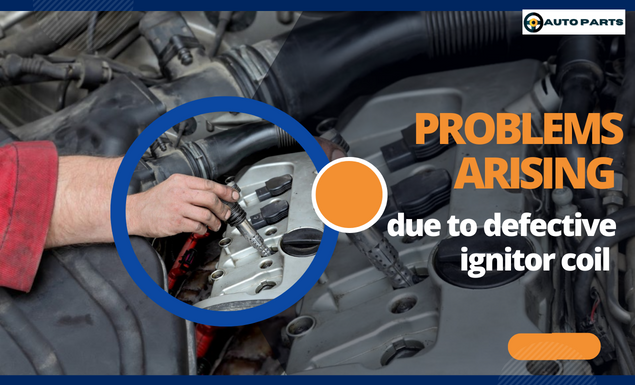
Here are the most common symptoms of a faulty ignitor coil:
◉ Backfire
Unburned fuel exiting the combustion chamber and igniting in the exhaust system can cause loud backfires. This typically happens when the spark timing becomes irregular due to weak coil output.
◉ Engine Misfires
A misfire occurs when the spark plug doesn’t ignite the air-fuel mixture. A defective ignitor coil can cause continuous or intermittent misfires depending on the level of damage.
◉ Spluttering or Stalling
If the spark becomes inconsistent, the engine may splutter, hesitate, or stall – especially during acceleration or when idling.
◉ Poor Fuel Economy
Incomplete combustion means the engine must burn more fuel to produce the same power. This results in noticeably higher fuel consumption.
◉ Shaking or Rough Idle
When one or more cylinders fail to fire properly, the engine vibrates, especially at idle. This is one of the earliest signs of a failing coil.
Diagnosing an Ignitor Coil
Proper diagnosis is essential because misfire symptoms may also indicate spark plug issues, fuel injector problems, or even compression leaks. Misdiagnosis can lead to unnecessary repairs or part replacements.
Here are the steps typically used to diagnose coil issues:
◉ Reading Misfire Codes
Modern vehicles equipped with OBD-II systems (post-1996 models) store misfire codes such as P030X, where X indicates the misfiring cylinder. While these codes point to a cylinder issue, they do not automatically confirm a faulty ignitor coil.
If the coil itself is shorted or has an open circuit, an additional code specific to that coil may appear.
◉ Using a Digital Ohmmeter
If no fault code appears, a digital ohmmeter can measure the resistance of both primary and secondary windings. Values outside the manufacturer’s specifications indicate a faulty coil.
◉ Inspecting the Spark Plug
Remove and examine the spark plug from the affected cylinder. Common clues include:
- Carbon buildup
- Oil fouling
- Incorrect spark gap
- Burn marks
These issues may indicate whether the misfire is caused by ignition problems or engine mechanical issues.
◉ Checking Plug Wires (if applicable)
In vehicles not using coil-on-plug systems, worn or damaged plug wires can mimic coil failure. Ensure the plug wire resistance is within the recommended range.
◉ Evaluating the Fuel Injector & Compression
If the coil, plug, and wire are all functioning correctly, the misfire may be due to:
- A clogged or dead fuel injector
- A compression issue caused by a worn valve or leaky head gasket
A compression test can confirm whether the cylinder has a mechanical fault.
FAQs
For PerTronix Ignitor systems, use a 3.0-ohm coil for four- and six-cylinder engines. For eight-cylinder applications, a 1.5-ohm coil is recommended. These coils are compatible with most inductive ignition systems.
The cost to replace a single ignition coil typically ranges from $65 to $325, depending on labor rates and vehicle type. The coil itself often costs $30 to $150, and labor can range from $30 to $200.
Driving with a faulty coil is possible but unsafe for your engine. Poor combustion can damage the catalytic converter and increase fuel consumption. It’s best to replace the coil promptly.
Common causes include overheating, vibration, worn spark plugs, moisture, short circuits, and general wear from age. A failing coil often shows early misfire symptoms.
Most coils last 100,000 to 120,000 miles, though lifespan varies depending on engine conditions, maintenance habits, and driving style.
If you’re looking for reliable refurbished auto parts, including ignition components, Auto Vehicle Parts provides high-quality international used parts for a wide range of vehicles. Visit the platform to find the right components at the best value.